Richard (Dickie) Drew served 1970 to 1994

My Life In The RN by Richard (Dickie) Drew
This is the story of my life in the Royal Navy, Bob Burton and I have decided to serialise it, I thoroughly enjoyed most of my time in The Royal Navy, and I hope you enjoy reading about it, therefore I would like to thank my Mother and Father for stopping me from continuing my secondary education and marching me down to the Labour Exchange, where there was Nothing For Me, so, while on the half mile walk back home, I thought I may as well join the Navy. So, off I went to the RN careers office in Exeter then later to Plymouth for the medical then to.…………………..
HMS RALEIGH 1970
The 28th September 1970, a day I will never forget when I signed on the dotted line! At HMS Raleigh, Torpoint, Cornwall, after the relatively short journey(compared to others) from Exmouth in Devon. I made a lot of friends here, however I can’t remember most of thier names, for some reason they called me Popeye or Smiler, probably because I was always laughing and joking around, and maybe my 2 dimples(the ones on my face). The nickname Smiler stuck with me for three years.
The day before ‘joining up’ my Mother had sent me to the barbers shop in Exmouth, it did not matter, all the recruits had to go and get a standard Naval ‘short back and sides’ haircut.
The First Photograph

Plumb-Wingate-Unk-English-Unk-Morris?-McKinall?-Terry Dunn-Unk-Unk
Homer-Unk-Drew-Flint-Unk-Davis
That first afternoon, we were issued with our kit, the chap in the queue behind me did not know his sizes, so I said: well you’re a little bit bigger than me mate, when I call out my sizes just shout the next size up, so it went: TROUSERS? My reply was 32, his was 33, SHIRT? Mine 38, his 39, SHOES? Mine 8, his 9. CAP? Mine six & seven eights, His: Nine, Ten, Eleven, Twelve,Thirteen!!!
Learning how to look after, wash and iron and fold my kit seemed easy for me, I was of a large family, one of eight and we had always looked after our own clothes from a very early age! But, in my twenty four and a quarter years in the RN, I must admit, I never did get the hang of spitting and polishing boots and shoes, mine always just came up ‘nice’ not ever like a mirror. But I never did once ask someone else to do it for me!
Bernie Flint you may remember him from Opportunity Knocks, the TV talent show, hosted by Hughie Greene, joined up with me and not forgetting Trevor English. Bernie was always singing and playing his guitar, he left the Navy after a short while, and went on to be the longest running winner of Opportunity Knocks. There was a young man(well older than me, which wasn’t hard, because I think I was the youngest recruit), he had a beard, and wore sandals on arrival so we nicknamed him Jesus.
Trevor, although a little older, took a similar career path to me.
Tea was the first meal I had in the Navy, it was a loaf of bread on the table to be shared of course, with a bowl of jam and some butter, not very posh but we were all starving. Needless to say, the cuisine improved from there on.
I will never forget the assault course at Raleigh, I could not crawl across that rope thingy across the ravine, and I hated the pipe full of water that we had to crawl through, but I loved the though, having done a bit during my childhood on and around the river Exe estuary. But did not enjoy having NO money, we were never paid enough for the amount of hard work we did Ha!
I will also never forget after being a naughty sailor for something, (Me naughty! NEVER) being sent running around the parade ground for what seemed like forever, with a Sub Machine Gun(SMG) at High Port Arms(virtually horizontal at chest height)!
They measured me to be 5 feet and 6 inches tall on the day I joined, and within a year I had shot up to over 6 foot! It must have been the change in diet, or maybe it was my parents genes had finally kicked in! But even to this day I am smaller than my four brothers.
We were trained and tested on marching, fitness, seamanship, Damage Control & Firefighting, Maths and English and more.
Prior to the end of the three month long course, I had to decide which Seaman Sub branch I would prefer to take, my first choice was Torpedo & Anti Submarine (TAS), second choice was Radar Plotting(RP) and my third choice was Gunnery, Why I chose in that order I do not know.
I left HMS Raleigh on the 22nd January 1971, after successfully qualifying as a Junior Seaman 1st Class(JS1), from my initial ranking of JS2. As the bus turned right out of HMS Raleigh’s main gates, I looked back thinking, I wonder if I will ever see that place again, and although I passed along the main road once or twice when I was on holiday some years later, I never did re-enter HMS Raleigh. The bus took us to Plymouth station where I caught the train to Portsmouth Harbour, to join HMS Vernon for my Part Two Training which was to be TAS. This was the first time I had to somehow carry a sailors kit bag, which seemed bigger than me! Along with a pussers case, and a grip with a few civvies(plain clothing) in, we had been allowed to bring these back from Christmas(Chrimbo) leave.
Talking of civvies and going back to my time at Raleigh, my brother Chris was also serving and his ship HMS Achilles visited Plymouth(GUS), and he took me for a drink in the January, I carried my civvies ashore in a plastic bag and got changed on a hill over looking the dockyard, went happily into Plymouth and left my uniform in a bush, and, YES! The uniform was still there, to my amazement on my return later that night,. That day I was asked to leave the Two Trees Public house, because I did not look 18 years of age! Ha Ha! Chris! What were you ever thinking of taking an underage boy into a public drinking house.
Next Part Will Come Soon
Dickie Drew
Readers: I am continueously adding to this ‘diary’, and, if you can help me with any ditties and memories that you have which include myself please email them to me.
Happy Reading
HMS VERNON 1971
Photo 3
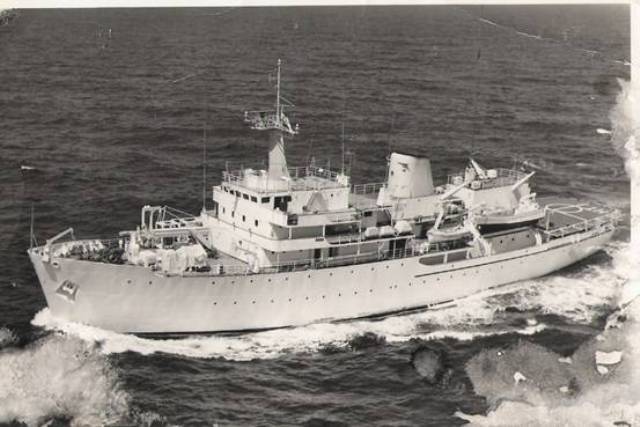
At HMS Vernon I successfully completed the Underwater Weapons Course(UW Course) and the Underwater Controllers Course(UC Course), by the way, as many of my readers will know, neither of these two courses were held under water.
Photo 4
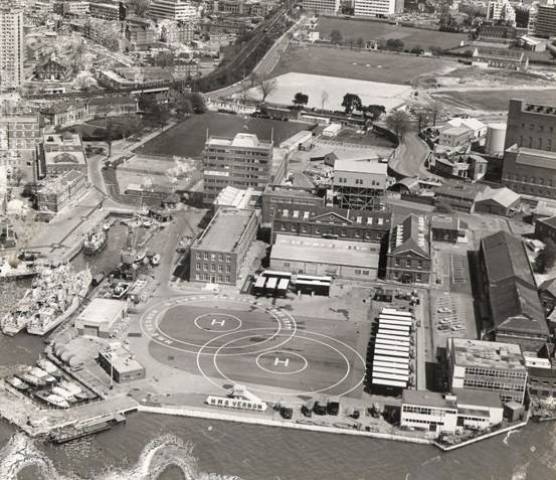
HMS Vernon from the west
Photo 5
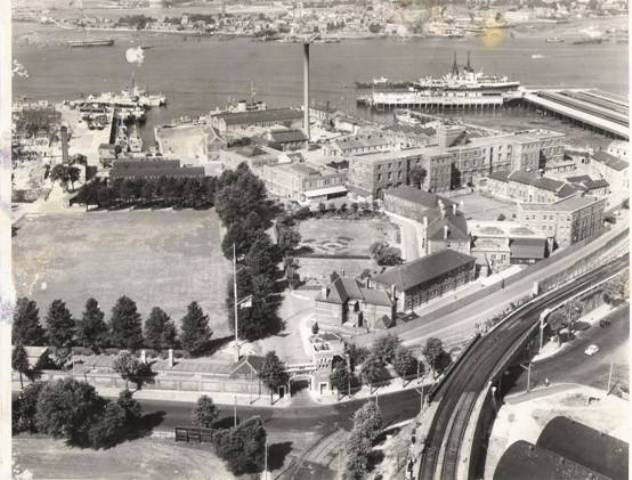
HMS Vernon and Gunwarf from the east
While at Vernon and between courses I had a loan draft to HMS Hardy a Type 14 Frigate for about a month. She visited Brussels along the Willebroek Canal, my first ever visit to a foreign country, and I experienced sleeping in a hammock for four weeks. While in Brussels for a four-day visit, it gave each member of the ships company the chance to have three nights shore leave, I think I may have got pretty drunk on that Belgian beer on all three nights. My bunk was hanging in the middle of the mess deck, and one morning at 0630 ‘call the hands’ I woke up and realised that my hammock was soaking wet, and I was soon to be shouted at by an angry senior Able Seaman who found his steaming bats(sea boots) full of urine directly below my hammock he was not a very happy man as you can imagine. Later, after I had cleaned and disinfected his bats, he saw the funny side of it.
I went on a coach trip to the site of the Battle of Waterloo, had my picture taken there
By the Naval photographer and it was sent to the Exmouth Journal, the local rag in my hometown, ‘Local Boy Makes Good’ Ha!
My only other memories of the Brussels trip was that the journey up the Willebroek Canal was very interesting and that it seemed as though we only just fitted within the banks of the canal, and of course who could ever forget the Mannekin Pis, probably Belgium’s most famous statue in Brussels of the little boy peeing.
I certainly had the micky taken out of me on this ship. One morning I was ordered to go down to the boiler room and get a bucket of steam, it took me ages to find something to use as a lid to try and keep the steam in the bucket.
The first time I was put on watch as the life buoy sentry on the quarterdeck, during the Last Dog Watch(1800-2000, I was amazed to see members of the after junior rates mess(I think that they were stokers) walking over the iron deck to the after hatch and down the ladder carrying their supper.
Later, I was sent on a loan draft to HMS Hecate, a survey vessel, which was surveying up and down an area off the Outer Hebrides, the most interesting train journey from Portsmouth Harbour to Greenock on the Clyde, was taken to join this vessel., not a lot happened while on the Hecate, except that I spent most of my working hours, washing, scrubbing, scraping and painting, and when it was finished we would probably do it all again. As the old saying goes: ‘If it does not move, paint it’.
Photo 6
HMS Hecate
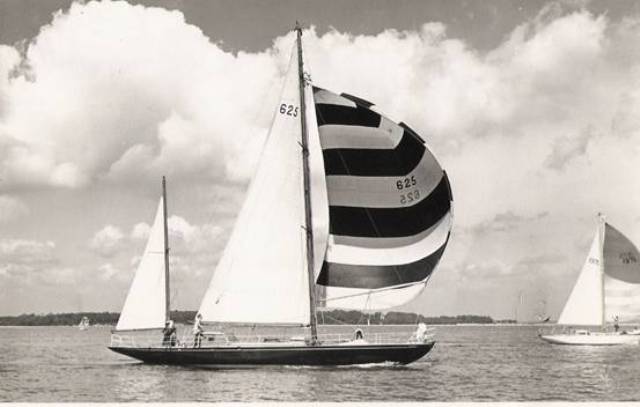
I also managed to spend about a week sailing on the yacht Rhona, we sailed around the Solent, and we also visited Alderney in the Channel Islands, as well as Cherbourg, before returning to the Solent for the remainder of Cowes week and took part in the Around the Island Race, which included Premier Edward Heath on his yacht the Morning Cloud.
When we passed around the Needles at the west end of the Isle of Wight, the wind speed dropped to zero, and most of the competitors reverted to motor power and accepted disqualification. Returning to HMS Excellent for the final day aboard.
The following morning I was duty chef for breakfast, and when putting the plates in the oven to warm, I knocked the oven, it moved and the frying pan slid off the top and the burning splashed onto my face, I was in agony and had to be rushed to RN Hospital Haslar in an ambulance.
Photo7
The Yacht Rhona
HMS NAIAD 1971-1972
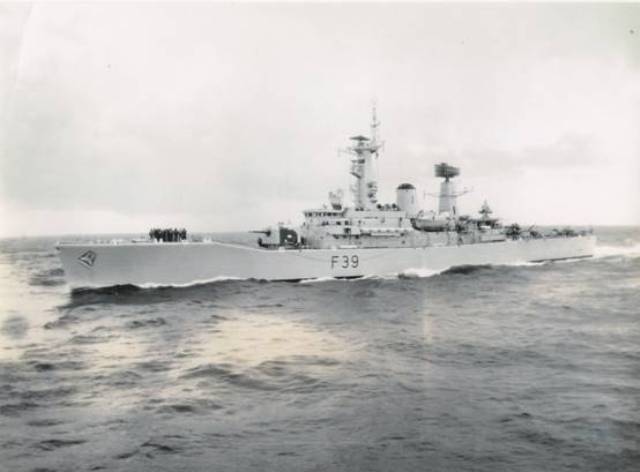
My first proper draft chit arrived at Vernon, and I was sent off to join HMS Naiad on the 18th August 1971. I remember spending some time in the autumn at Portland, some sort of workup! While at Portland I experienced seasickness for the very first time. I was bosuns mate on watch, and I asked to be excused to the heads, and I had my head down the pan for what seemed like ages, during this time, I recall the PO of the watch on deck calling me in the heads to see if I was OK! This was the first of only two occasions during my twenty-four and a quarter in the RN that I was physically sick I could still taste the diced carrots to this day.
Photo 8
HMS Naiad
Reward for the success at Portland, was a trip to the Mediteranean sea and Malta stopping at Gibraltar enroute. What an Unusual place this is, now, should it belong to Spain, it certainly should and it certainly should not, it should because of it’s location, and it should not because of what it is, since my first visit there it has grown in size by the reclaiming of land from the sea, Gibraltar is what it is today because of what the British have done to it. I have always enjoyed visit the place have always found it interesting, and it seems to have it’s own type of weather, i.e.: when it rains, the rain seems to come from it’s own rain cloud that hovers over the rock, be careful where your standing when this happens as the rain just pours d
Down the streets to the sea.
Photo 9
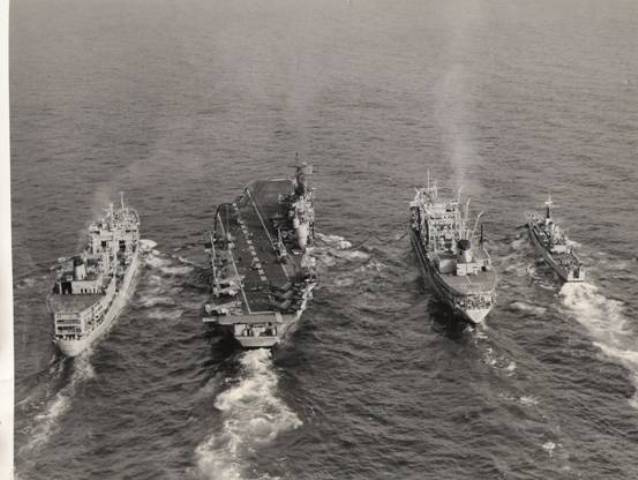
Replenishment at Sea: RFA Regent-HMS Ark Royal-RFA Olmeda-HMS Naiad
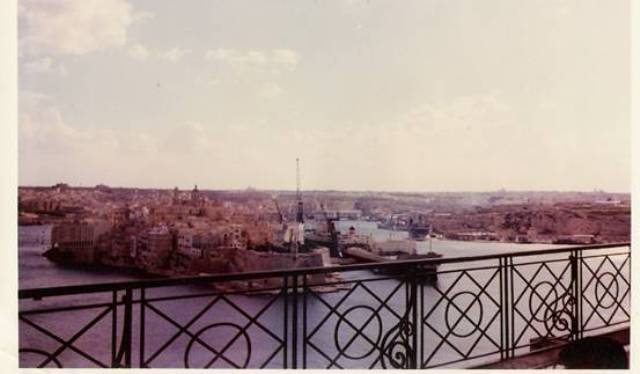
While in Malta, I was Bosun’s Mate on the gangway, and there was a bit of a panic late at night, as some ratings missed the last liberty boat across Valletta harbour, and they decided to swim instead! Malta was very interesting especially at night, the local bar area Strait Street(Strada Stretta) was known as the ‘Gut’ this was an area of small bars in a narrow street probably not a lot more than 10 feet between the front door of bar to the front door of the bar across the street. This was to be where as soon as the sailors landed for shore leave, most would instantly head for. Some of these bars were known as dance halls, and you could meet a young lady, but it would probably cost you a bit to go any further, I remember that none of the ladies were particularly pretty. Nearly all the toilets were behind a curtain and one had to squat over or pee into a bucket.
Photo 10

Valletta Harbour with HMS Naiad in the background
Some time in the spring of 1972, we were travelling across the Atlantic Ocean(Pond)
To visit the United States of America and the West Indies, one morning a piston on the starboard turbine blew off, and the decision was eventually made to return to Portsmouth for repairs. I had meant to have had the morning watch off, but still got shaken early on, what a disastrous trip for me as I was so looking forward to America.
HMS EURYALUS 1972-1973
On the 11th May 1972 I joined HMS Euryalus, if my memory is correct Naiad went into a refit and took the place of Euryalus, and a large proportion of the crew from Naiad transferred over. Shortly after I was promoted to Ordinary Seaman.
Photo11
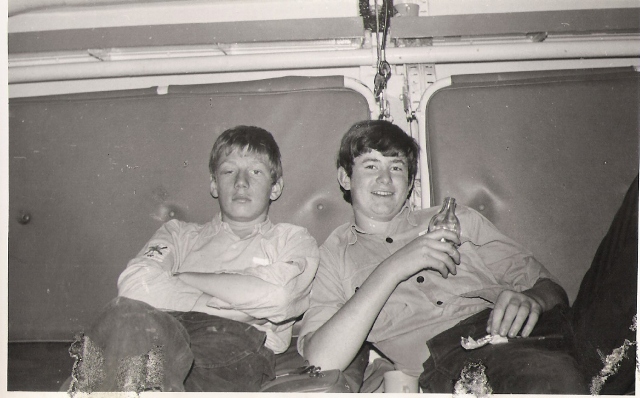
In July of 1972, we sailed for the Far East. This trip was to last for nearly 6 months and we returned to Portsmouth just before Christmas of that year.
Photo12
HMS Euryalus
On the way to Hong Kong we visited: Gibraltar, Senegal, Simonstown(Capetown), Mombassa, Durban, Gan, Penang, Singapore(twice), and then back to Capetown, before a 3 week journey back to the UK. We spent one month as Hong Kong Guard Ship, Susies side party kindly painted the ships side for us, I loved it in Hong Kong, as I spent every single night ashore except for one, I was able to do this because at the time I was after PO’s mess messman(Blue Card), the reason for spending the one night onboard was because me and my mate Windy knicked a Rickshaw. This I realised later was to be one of the dumbest things I ever did, as a gang of what seemed like half of the male population of Hong Kong, chased us through the streets, with me on one side of the Rickshaw and Windy on the other, No more sweet and sour pork for us during our stay. Needless to say, we denied all knowledge of the theft of the Rickshaw to the Master at Arms(Jossman) knew it was us, so he stopped us one nights shore leave.
On the 22nd August I was awarded my UC* badge.
Part of our journey back to the UK took included a couple of weeks on Biera patrol, the ship that we relieved I believe was HMS Andromeda a few inter-ship sports events events were carried out, one being deck hockey, this is a game which takes place on the flight deck between two teams of five or six with a coat made out of a piece of rope about seven to nine inches in diameter covered with black tape, it can become a pretty physical game one of the reasons why steaming bats are worn, many a coat would be lost over the ships side. Another game is flight deck volleyball, where the ball would be taped to a long piece of light rope, this can be quite dangerous at times as the rope can often get caught around one of the players necks but at least the ball is not lost.
At Simonstown the train had to be caught to city of Capetown, We used to by a bottle of Cape Brandy for about the equivalent of £1, and share it on the train, we used to frequent a nightclub called the Navigators, how we ever found it each night I do not know. I met a girl here called Caroline, this was the first time that I felt that I had fallen in love, however, I could not visit her home and her parents because she was of a different colour to me, and this was not the done thing at the time, we wrote to each other(well I actually did most of the writing) while my ship was away in the Far East, until our return to Simonstown in early December, Caroline and I met up for the final time and obviously we called it a day before we set sail again for the return passage to the UK.
A few days after our departure from South Africa we had a mail drop, this is when an aircraft drops canisters loaded with mail or other items, and the ships boat is launched to collect the canister(s) from the open sea. Many of us were stood on the upper deck watching the drop, the canister came down from the fixed wing aircraft and on contact with the water the canister smashed to bits, this as it turned out was a wind up and another canister was dropped shortly after.
Photo 13
Thomo and Me in after seaman’s mess
HMS DEFIANCE 1973
On the 8th February 1973 I joined HMS Defiance(Used to be HMS Forth), a submarine depot ship based in Guzz, I was one of a few seamen onboard, I can remember learning how to play Nominations(Noms) and Poker while here. We took it all very seriously, it was as though each day was based around the game of cards at Stand Easy(morning break) and lunchtime,
I wasn’t much interested in the game of Uckers prior to this period in my career.
Uckers is a board game based on the game of Ludo, the aim is basically the same, to get all your counters around the board as quickly as possible, you can either have 2 or 4 players. The game is normally played on a wooden board normally about 20inches by 20inches, and around an inch thick, the counters would have be sewn from a broom handle and would be up to half an inch in thickness. The rules have been modified from the game of Ludo and the game can become quite tactical. Not only do the lads on the lower deck play it, but members of the wardroom do too, the piling up of ’blobs’ made by counters of the same colour, create calls like ‘UP BLOB’, depending on how many counters in a blob, causes various challenges
from the opponent to overcome or delete this ‘blob’. In my time I had experienced inter mess challenges, as well as inter ship challenges. Some mess decks would either have a portable Uckers Board or a more permanent board incorporated into a coffee table, I have also seen a canvass board almost the size of frigates flight deck.
I tried playing football, but I was never very good at it at school and there sadly was no improvement during my time in the Navy either, which is a great shame as I am mad about football, most people who have ever known me will know that I am a big fan of Exeter City FC.
Photo 14
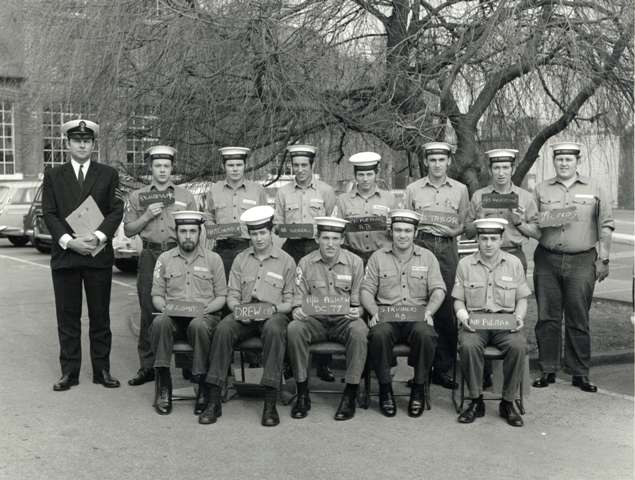
UC2’S Course, DC79
I was temporarily drafted back again to HMS Vernon in March as an Ordinary Seaman UC* to do the UC2’s(Underwater Controller 2 star) course, and while on course I was promoted to Able Seaman UC2 departing Vernon on the 4th June1973 as an Able Seaman UC2. back to Defiance, I then went to the Ship Husbandry School and learnt how to clean and paint properly, and use paint spraying equipment, I returned to HMS Defiance and became the ships paint sprayer, the buffers party used to tape up and cover things (basically, anything that moved or had writing on it) in a compartment during the day and I then sprayed the compartment during the night, I can remember that it was a very lonely job, I was all by myself, and no one to play cards with, but after a few weeks and the ship now painted within, I went back to day working.
I left HMS Defiance on the 9th December and the following day I joined HMS Bristol, which had only been commissioned a few months prior to my arrival, this was a beautiful looking ship. In the 2 ½ years or so that I spent on here, we never went anywhere exotic, although I can remember having a great time in the ports that we visited, namely Liverpool, Bristol, Rotterdam Gibraltar and Madiera, we were programmed to cross the pond in 1975, but the fire that started in the Steam Turbine room, while in Milford Haven Harbour South Wales, put a stop to all this ‘Jolly’ business for the Bristol.
HMS BRISTOL 1973-1976
Photo 15

HMS Bristol
At the time I was TAS Party, and late in the evening I believe around 11.30ish, we were duty watch of seamen waiting for the return of the last two liberty boats(the ships two workboats). One of them was coxed by LS Jim(Rab) Butler, I had been promoted in his absence, temporarily to Duty Leading Seaman, I thought that the Quartermaster actually ‘piped’ FIRE,FIRE,FIRE,………..FIRE IN THE S.C.R.(Sonar Control Room), I was wondering what piece of equipment I had left on, but NO, when the ‘pipe’ was repeated it was clearly FIRE, FIRE, FIRE ……..FIRE IN THE S.T.R.(Steam Turbine Room), needless to say, from that moment onwards it was HELL, but we managed to save the ship, and no loss of life. From what I remember just minor injuries from smoke inhalation. I will never forget : shaking all the Petty Officers in the mess directly above the STR, boundary cooling in the cabin flat 3 levels above the fire, cooling the bulkhead only one section in front of the Seadart Magazine, and abandoning our cooling hoses on the funnel deck, just prior to the Welsh Fire Brigade boats aiming their hoses and flooding the uptakes/downtakes from the STR, although this extinguished the fire, apparently it also almost sunk the ship, as we had not got enough pumps running to discharge the water. I think that I can honestly say that this was the worst night of my life, as the final flames did not go out until around 0600 – 0630. It was a fuel pump that burst a pipe and was shooting out flames! And although a lot of lessons were learnt from this experience, it was a thoroughly professional job carried out by the ships company.
Rab, and the liberty men finally returned to the ship at around 0700, having witnessed it all from the bay of Milford Haven, Pembrokeshire.
When I arrived at North Corner Jetty in Portsmouth Dockyard, I stood on the jetty for quite a few minutes admiring this lovely looking ship thinking how lucky I was to be joining her.
Some other AB’s I remember from those days were: Jimmy Bond from Efford and Nish Brown, Steve Livesley was a very good friend of mine, I wonder what happened to them.
My first job on the Bristol was ‘Captain of the heads’ this meant that I was responsible for cleaning the after Romeo section junior rates toilets. I loved the job, it meant that I could set my own routine and have as much cleaning equipment as I wanted, I was basically my own boss, providing of course I kept it all nice and clean which I did, I’ve always loved cleaning it is one thing that I am good at. Even in my present job it is so satisfying when someone walks in the front door and remarks how nice the main hall looks.
Photo 16

HMS Bristol's Guard during the ‘Freedom of the City’ Ceremony
I am the right hand marker, on the left
Prior to the freedom of the city ceremony in Bristol, the guard on occasions before the ship sailed for the weapon range, would be dropped off at Aberporth and we borrowed the station platform for guard training. We were practising the fixing of bayonets, as some of you will know this is done in three movements, on the first movement the right hand is to go to the bayonet handle and twist it around at the same time pressing the release catch, well on this particular occasion, my bayonet would not release, so I was struggling to be ready for move number two, I struggled and struggled and when the order ‘2’ was given by the Petty Officer of the guard, I was putting so much effort into it the bayonet finally came out with so much force in a semicircular movement, I stabbed the chap to the right of me in the middle of the cheek of his left bum, there was blood everywhere!
We marched all over the City centre and then paraded on the main green(see photograph), then we had a wonderful party in the Town Hall.
I believe that being given the freedom of the City means you have the right to go just about anywhere in the city, but of course when it comes to it this is not strickly true.
We were to be in dry dock in Portsmouth naval base, and the accommodation ladder was being lowered by members of the buffers party. Chats/Harry Harris was stood on the upper platform when the hydraulics tripped, wearing no safety harness he was shaken off to the bottom of the dry dock, he later died in the Royal Hospital in Portsmouth.
I think it was before the fire, we visited Madiera, and my Part Of Ship(P.O.S) was Boats Party at the time, we had two twenty foot workboats(already mentioned) an Atlantic’ R.I.B. and a Fairy Huntress, it was a great job looking after those boats and the deck around them, quite often when I was tired I got inside one of the boats and fell asleep under the canopy. However, after the first night ashore in Madiera, my Petty Officer decided to take the Huntress out for a spin, it was fast enough to tow a skier, and boy did he know how to handle it, sadly on this occasion he chose me to be the crew, he threw it around all over the bay of Funchal, and suffering from the influence of Madiera wine and Mateus Rose’ (Matelot’s Rose’), you can imagine what I was going through.
The ‘Part of ship’ to clean included the main mast, I believe at the time was the tallest mast in the RN, I was often seen to be hanging off of this mast on a bosuns chair, in those days all you hand as safety was an Oppo and a safety line tied around your waist.
I remember one morning, a communicator was cleaning the yardarm on the forward mast, he fell off, and hung on his safety harness for what seemed like ages, he eventually pulled himself up, climbed back along to safety, went down below for a cuppa, and returned to his ‘post’ on the starboard yardarm 20 minutes later, what a brave man. I am lucky to have never been afraid of heights, when I was a young boy, I used to love going up the tower of All Saints Church, where I was Head Choir Boy, and sit there for ages, and I was often seen climbing out of the bedroom window and climbing over the roof, for some unknown reason, needless to say, I learnt my lesson one morning when I fell out of a conker tree!
After the repairs to the damage from the fire, we finally went to Portland for a Work Up, I remember one day, when we had had everything thrown at us, I was sent down to the Quarterdeck for something probably to launch a Bathythermograph, and on my return I decided that I had had enough, and on entering the S.C.R. I collapsed and pretended to be unconscious, the Flag Officer Sea Training (F.O.S.T). staff went along with it, and I was carried to the Sick Bay where I enjoyed a relaxing end to the days exercises!!!
I loved it on the Bristol, the only thing I do remember not liking much was the smell of the Leading Regulators feet while he was billeted in the watchkeepers mess, the other mess I was in was 4R Starboard.
We visited Liverpool, in fact Birkenhead. What a wonderful place. Although I did venture into the City on one occasion, the locals in Birkenhead were so hospitipal
I did not feel that I had to go much further than half a mile from the ship. I frequented a local pub where the card game of Nominations was popular, and I was often told what a big risk taker I was, I always seemed to win.
On the day a group of us decided to walk into the city, we decided that the quickest route would be through the Mersey Tunnel, NO! we were warned off of doing this by the armed guards.
During my time on Bristol I studied for promotion to Leading Seaman (Sonar)LS(S), yes! By now it was no longer known as Underwater Control(U.C), it was now to be Sonar. I completed the task books and was promoted to Acting Leading Seaman (Sonar), and then eventually made my way back to HMS Vernon where I successfully completed Leading Seaman courses.
HMS LOWESTOFT 1977-1979
For some reason I was selected for Passive Training at HMS Vernon, George Forster and Derby Allen were the other 2 Killicks (Leading Hands) on the course, we were all to pass and were drafted together to HMS Lowestoft. At the introduction of the course we were all asked to stand up and introduce ourselves, I said that my name was Richard, sometimes known as Jan, AND George Forster jumped up and announced that ‘From this moment on you will be known as ‘Dickie Drew’’ and that name stuck with me from 1976 to this present day!
My seniors were correct in picking me for this ‘sub-branch’, as I apparently became an expert at the techniques of Passive Sonar Analysis, Well done to them.
This is the third part of my serial “My life in the Andrew” I have added a lot more to the previous two. If you would like to read the previous chapters please email me and I will send them to you.
HMS LOWESTOFT 1977-1979
For some reason I was selected for Passive Training at HMS Vernon, George Forster and Derby Allen were the other 2 Killicks (Leading Hands) on the course, we were all to pass and were drafted together to HMS Lowestoft. At the introduction of the course we were all asked to stand up and introduce ourselves, I said that my name was Richard, sometimes known as Jan, and George Forster jumped up and announced that ‘From this moment on you will be known as ‘Dickie Drew’, and that name stuck with me from 1976 to this present day!
My seniors were correct in picking me for this ‘sub-branch’, as I apparently became an expert at the techniques of Passive Sonar Analysis, Well done to them.
Photo 22
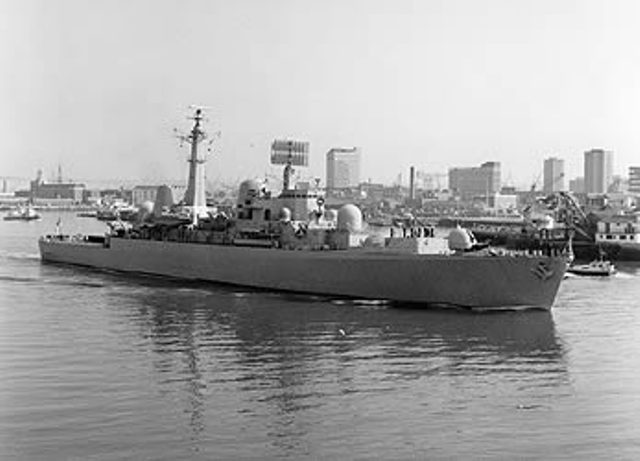
HMS Lowestoft
I joined HMS Lowestoft in the spring of 1977, My main place of work was to be
in a large steel container on the flight deck, therefore no room for a helicopter.
It was like going back in time when I joined the Lowestoft, my previous ship the Bristol was a beautiful modern warship, compared to the Lowestoft launched in
1960.
One of the Trials team as we then became known, was Kev Lucas(a young Ordinary Seaman at the time) he once mistakenly wrote Trillies instead of Trials on a memo one day and from then on we were known as the Trillies, or Trilly Frillies!
One night when we returned from shore leave, I remember George Forster at the top of the quarterdeck ladder, with his willy out and someone half way down holding on to it, I think George wanted it stretched!!! OOOOOH OOOOWWWCCCHH!!!
George, you did used to drink far too much you know mate!
We spent the next 3 years or so carrying out deep water trials on the sonar, and visited Gibraltar 42 times, Tangier, Falmouth, and Lowestoft(twice), the whole of the ships company worked very hard, we were forever in and out of some harbour collecting spares for the trials, and not getting much leave.
Once when we were carrying out deep water trials, I was standing on the cat walk above the sonar winch as we were recovering it, and one of the trials officers shouted ‘corr! Look at that! And over to the port side just literally alongside us was the largest whale I had ever seen, it was obviously attracted to us by the noise of the winch, maybe it was trying to mate with the ship, that would have been a laugh if it had, it stayed alongside for what seemed like hours. We did everything the Civilian Trials Officers asked of us and more, producing an awful lot of paperwork, most of the ships company did not have a clue what we were doing as it was too highly classified, but they were very patient and supported us in every way possible
We visited Tangier a port on the Mediterranean coast of Morocco, this particular night I was duty watch, a storm was blowing, we had to go and sort out the hurricane hawsers on the forecastle and quarterdeck. While on the forecastle my watch got caught on the rope and flicked off, it now lies at the bottom of Tangier harbour.
I have always run to keep fit, running was one exercise that I could do easily and on my own as and when I liked, I have been running since my school days, I once completed the Poole Marathon, and have done some other Half Marathons and 10K runs. I am even planning on running the Great South West Run in May of 2008, even though I suffer with Parkinsons Disease.
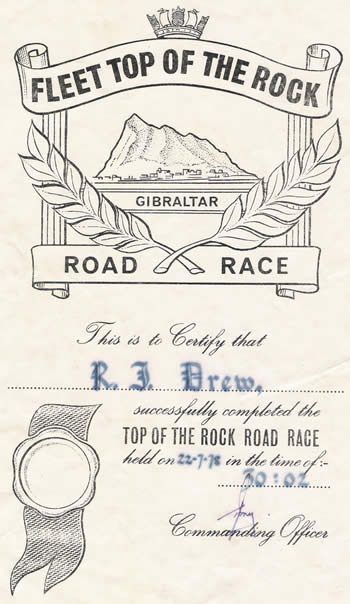
In July of 1978 I participated in the Top Of The Rock race, this I completed in thirty minutes and two seconds, this is by no means a winning time but I came tenth which was very satisfying, my only worry was how to dodge the apes which live about half way up the rock of Gibraltar, luckily they were nowhere to be seen it was a certainly alot easier walking back down.
I was promoted to Acting Petty Officer on the 11th January 1979, I had finally achieved something I had never even thought about eight years and four months earlier when I walked through those gates at HMS Raleigh, it was an outstanding occasion for me and my Mother was over the moon with joy! God Bless her.
There was a scuttle(window) in the forward Petty Officers Mess and when we had a party we used to have a ‘scuttle run’ competition, the participant had to crawl through the scuttle, up onto the deck of the forecastle run across and down through the scuttle on the port side and out of the heads and back into the mess, if my memory serves me, the record was one minute and thirty seconds, of course we only did this when alongside the wall in harbour, it was of course a very silly thing to do especially after a few pints of beer.
One thing that I always made a point of. throughout my career was, when I arrived at each and every port, I always looked for the nearest telephone if we had not connected to shore telephone lines, and let my parents know that I was safe, and of course where I was in the world.
For a few reasons, which were mainly political promises made by the then and future governments, my pay nearly doubled within a few months of being promoted to Acting Petty Officer.
A ‘Sods Opera’ is a little like a talent show held on the flight deck one evening often on the return passage back to the UK. Kev Lucas and Jan Davies and I somehow managed to find materials to dress up as the Supremes and after many rehearsals sang and did a dance routine to ‘Baby Love’, It brought the house down and we were called for an encore.
HMS VERNON 1979
I Joined HMS Vernon in the January of 1979, and soon after I began my Petty Officers Qualifying Course(PO(S) Course. In the few weeks before the course began, I did a stint of instructing Passive aural techniques and analysis, this I thoroughly enjoyed. My students were mainly young seamen but a few were senior ratings and Officers. I soon found that teaching was a very satisfying job, and really did suit me.
Standing in front of a class and giving the members of the class my knowledge skills and sharing my experiences was good for the ego! I will give more detail on this subject later and towards the end of my career when at HMS Dryad, The School of Maritime Operations.
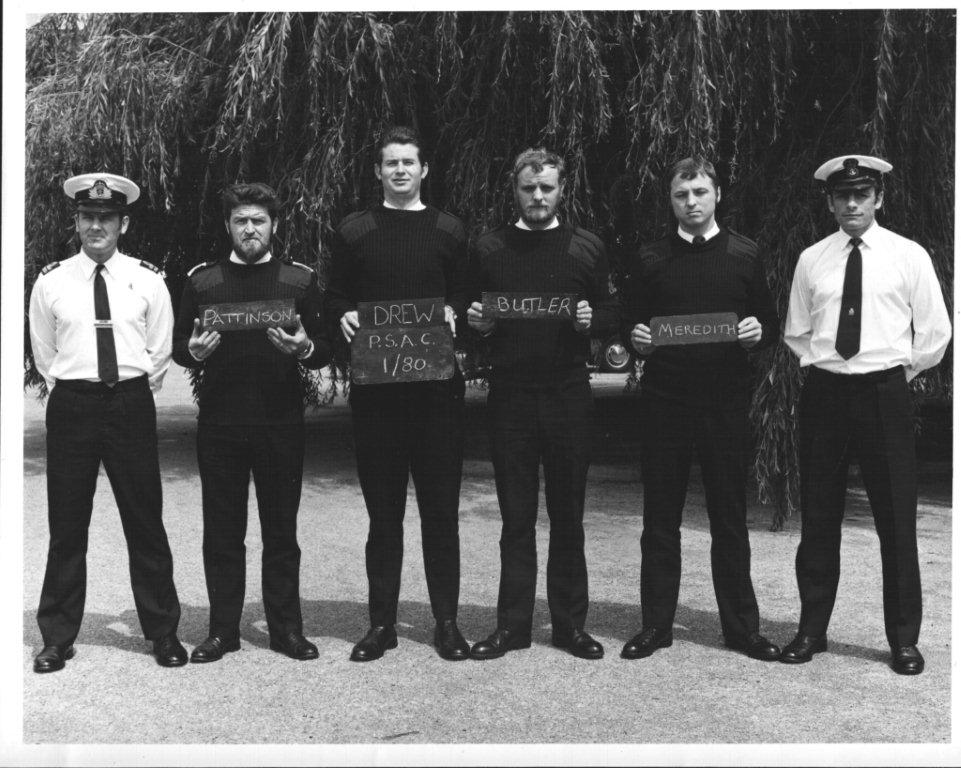
During 1980, I participated in the Petty Officers Sonar Course the Senior Rates Passive Analysis Course qualifying on the tenth of October, visited HMS royal Arthur near Corsham Wiltshire for the Senior Rates Leadership training, qualifying on the twentieth of November and the Petty Officers Seamanship Course on the Twelfth of December. I was confirmed Petty Officer Sonar on the eighteenth of December 1980
Photo 23

Lt Astle-Pat-Pattinson-Me-Rab Butler-Steve Meredith-Jake Lake
The second Senior Rates Passive Sonar Course
HMS ROYAL ARTHUR OCTOBER 1980
It was October the 16th when I arrived at Royal Arthur for the Senior Rates Leadership Course Number 1620. I would like to think that I was very fit on arrival, mainly caused by the rugby training that I had been doing at Vernon, and all of the physical tests that we had seemed quite easy. One of the first tests was in the gym, and we had to do as many sit ups as possible, I got as far as 350 and the Physical Training Instructor(Clubswinger) had to stop me because I was going on for too long and was delaying the next lesson. As I have said before I loved running at school and had continued this; we had I think three running tests while on course and I easily passed all of them, the third and final one was the most difficult as I had a large blister on my right heal that was very very painful.
We had to produce and perform a play based on a famous leader, my group wrote and performed a short comical play based on Leutenants Chard and Bromhead the two Officers in charges of Rourkes Drift the iconic defence of the mission station by a small force of British and colonial troops during the Zulu war on the 22nd January 1879 at Tugela River in Natal Province South Africa which saw a record number of Victoria crosses and restored the faith of Victorian Britain in the army.
We were assessed on various Practical Leadership Tasks(PLT’s) and towards the end of the course you were given a major task to take charge of, mine was to be the final exercise of all, the ‘stroll’ over the Black Mountains! By this time the blister had got a lot worse and I had to put a lot of padding between boot and skin(what skin there was left). We were told that some Royal Marines had been exercising over the Black Mountains during the weekend prior to our visit, when the weather had been so bad some Marines had had major problems and apparently one had died. This bad weather had continued throughout the week, and we had been secretly hoping and praying that our weekend would be cancelled. Of course it was not, and on the last Friday afternoon of the course, we travelled up to South Wales in the bus to the base camp, packed our rucksacks with the ration packs, tents etc,(and then were briefed on the area that we would be covering in order to gain points from answering as many questions enroute as possible),We had about 2 or 3 hours sleep, then we set off at 1am, in pitch black over the mountains.
Before I joined the Navy I was in the Boy Scouts and had completed two Ten Tours expeditions over Dartmoor, my mates and I had practised for both years navigating our way over Woodbury Common in East Devon and then finally a few weekends over Dartmoor before the big event, I knew and loved Dartmoor pretty well, but never had I experienced anything like I was about to in South Wales! It was not very wet and windy as we set off over ‘Them Thar Hills’, but it progressively got worse, and as we neared the Northern end of Offa’s Dyke(No that is not where the Lesbians lived), we came across a very muddy area which took us about 2 hours to walk about one mile, it was hell, we finally decided it was time to find somewhere to settle down for the night and pitch tents and make camp The The wind was so strong we walked or almost ran down this hill to find as much protection from the wind and rain as possible, we finally found what we thought could be a good spot on the side of a hill, as we tried to put the tents up it became increasingly more difficult, so we decided to gather up the camping equipment in our arms, and again we literally ran down the hill to the bottom, and set up camp near a river. The visibility was also very poor, and on awakening in the morning, we found that we had actually camped in quite a hazardous area, as the river level had risen quite high over night and the water was nearly all around us, it was a wonder that we had not been washed away. The weather had improved dramatically overnight, and it turned out to be a beautiful Sunday
We continued our walk and eventually found our way back to base camp with only 10 minutes to spare, if we had been late we would have been deducted points. I was very proud when the announcement was made by the Instructors that my team had won.
We achieved this by acquiring the lowest ever amount of points by a winning team.
That just goes to prove how hard it had been.
Having completed my Petty Officer training, I returned to HMS Vernon where I joined up with the sonar Instructors, until I departed for my next sea draft.
Photo 24
HMS VERNON rugby 7’s winners
Pete Sully-Jamie Hutchinson-Scouse Harrison-Pete Stankovitch
Unk-Dickie Drew-Jake Lake-Unk
HMS PHOEBE 1982-1984
During my time on HMS Phoebe I experienced the lowest points of my Naval career. I will deal with the lowest first:
It was at Portland when we were embarking a new sonar array onto the winch on the quarterdeck, the towing cable was half as thick as the array of Hydrophones, when nearing the point where the two were joined I had to ensure that the jaws on the winch were opened up to receive the wider array section, before widening the jaws the winch had to be stopped, I was not paying full attention and we all heard the noise as the array section started to get crushed as it entered the jaws. I had supervised this operation many times before, but this did not prevent me from causing damage to a piece of equipment that cost something in the region of £250.000. Needles to say we had to wait a day or two while another array was delivered to the ship.
I was a Petty Officer who had served approximately 14 years in the Royal Navy, and now was the time to be completely and utterly embarrassed when I eventually was called up to the Captains Table and awarded a severe reprimand in front of witnesses who were members of my own Petty Officers mess, my friends, my pals, my chums, my OPPOS!!!
This meant that unless I spent more than the normal 22 years man’s service in the RN, I would not be awarded the Long Service and Good Conduct medal which one would normally deserve after seventeen years service, because I now had a break in good conduct.
Photo 25
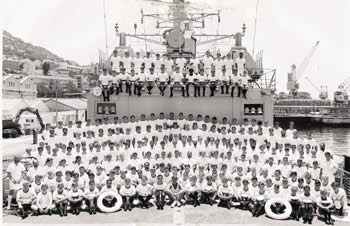
HMS Phoebe Ship’s Company
I joined HMS Phoebe on the 23rd February 1982, I was to be one of 3 Petty Officers(Sonar) onboard, John Smith and Brandon Surtees were the other two.
Shortly after, in April the Falklands war started, and the work that had begun to enable the ship to carry the Towed Array Sonar, for which I would be responsible, was put on hold, so I was drafted back to HMS Vernon, where I did some instructing for about 6 or 7 weeks. During this period the hierarchy decided that they would like me back onboard to help make preparations for the sonar fit while away in the south Atlantic. So, I returned on the 4th May 1982, in Chatham dockyard Kent.
We were on our way to the Falklands War, there was extra equipment fitted We were in the lock between the Dock and the River Medway enroute to Portsmouth when the Captain announced on the Main Broadcast system that the Argentineans had surrendered and there was to be no war for us, we were to relieve the first batch of ships to return from the conflict. Eventually we arrived in Portsmouth where we ‘topped up’ with stores and ammunition and proceeded to sea where we worked up the ship.
During the passage to the South Atlantic we stopped for a day and night at the Azores to take on some stores and do some fishing which was easy as the most colourful fish I had ever seen would snap at anything even an empty hook with no bait.
Shortly after leaving the Azores we rendezvoused with the first ships returning from the conflict, I bet they were pleased to see us.
One of my other duties was Petty Officer of the dump during replenishment at sea (refuelling) the dump is the area where the fuel hose is connected to the ship from the fleet tanker.
I became a temporary reporter for the Bournemouth Evening Echo; I sent a few short reports just to let the locals know how we were getting on.
I remained onboard for a total of ninety-six days, until the last possible trip ashore to Pebble Island, Some friends and I took one of the ships boats ashore and we spent a few hours exploring some of the island. As we stood looking out to sea hundreds of penguins swam towards us and as they ‘hit’ the beach stood up and waddled within feet of us, what a fantastic experience. Shortly after around the next cove we came across the carcasses of beached whales. We were welcomed into a cottage by some islanders for tea and sandwiches. Shortly after our return to the ship we set off on our return journey back to the UK.
During the passage home we had a Sod’s Opera, my team of actors from the Petty Officers mess performed a re-written play based on the Sources Drift performance I had taken part in at HMS Royal Arthur.
A lot of my time while down in the South Atlantic and beyond was spent as Chief Quartermaster, I only had a few ‘lads’ to take charge of and we only had a small PART OF ship to keep clean and tidy, this was mainly a small lobby at the rear of the hangar where most of the gangway furniture was stowed. During a normal working day most of my small team were either on watch or off watch sleeping.
I spent my spare time preparing for the eventual fitting of the Towed Sonar and was often seen crawling around the engine and boiler rooms checking for noise shorts, my aim was to produce the quietest Leander Class frigate afloat of which I succeeded, I put my heart and sole into this, and this enabled me to be selected for my next appointment after the Phoebe.
The nearest I ever got to any hostilities during my career was when I was Petty Officer in charge of the shore patrol during a visit to Cadiz in Spain.
I was with my squad on one corner of the main square and two of the other corners were occupied by some local youths and some members of the Phoebe’s ships company. I was in contact with the Officer of the day onboard via a radio asking for advice, but he could not help me much as he said just wait and see what happens and then we would decide on what action to take. I think that just our presence pacified and calmed the situation luckily, but it was pretty scary at the time.
In the spring of 1983 we sailed to the Mediterranean Sea, for naval On-Call Force Mediterranean(NAVOCFORMED) and joined up with other frigates from the USA, Greece, Turkey and Italy.
What a great trip this was, we exercised for a few days between visits that included Gibraltar, Palma Majorca, Monaco, La Sepia, and Catania before sailing independently to Alexandria.
While in Monaco/Monti Carlo a few of us took the opportunity to walk the route of the Grand Prix which had been held only three days previous.
There were some exhanges of personnel from ship to ship. I was transferred by helicopter to the Italian ship. On my return to Phoebe, the flight deck Officer informed me that when being hoisted up off the flight decl the helicopter tilted and apparently the rotor blades had been inches from my head it was a very worrying time for the personnel stood watching from the flight deck I, of course did not have a clue what had been going on.
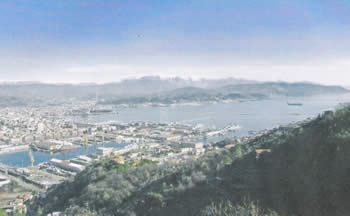
While in La Spezia Italy, Tom Stevens and I spent an afternoon in the ship’s canoes and paddled across the harbour to a small coastal town, we secured the canoes on the beach and proceeded to the nearest restaurant for a meal of spaghetti and a bottle of the local wine. This was a mistake, because during the return journey Tom was ahead of me, and the influence of alcohol caused me to have a bit of a wobble and I turned the canoe over although wearing a life jacket I had great difficulty in turning the canoe upright, I was stuck upside down and I was very close to drowning. After a great struggle I managed to slide out of the canoe. I was floating in the water while holding onto the canoe for what seemed like a lifetime, a very large container vessel passed close by, and eventually an Italian fisherman came to my rescue and pulled me into his fishing boat, exhausted I managed to help him turn the canoe upright and got back into it and paddled back to the ship, I was in a state of shock and on my return Tom had no idea what had happened to me. I have had a few scrapes in my life but this was the closest I had ever come to dieing. La Spezia has one of the largest natural harbours in the world.
Photo 26
La Spezia and its harbour
We sailed through the Messina Straits to Catania. Where the five ships companies took part in ceremony to end the period of exercises. We then sailed off on our own to pay a visit to Alexandria, where I took the opportunity to visit Cairo, this was by a coach journey through a desert and along the edge of the river Nile finally reaching our destination at the pyramids at Giza then back to Alexandria by midnight. One night after a visit to a local bar where there was also a belly dancer, she was good, we decided to catch a horse and cart back to the ship, I don’t know what my mate John Smith was playing at but the wheel of the cart ran over his foot, all we could do was laugh.
During the trip away we had planned for our return to do a charity relay run between Plymouth and Bournemouth arriving at the same time as the ship at Bournemouth pier. The Devon and Cornwall police strongly advised us that it would be dangerous, so the next plan was to run a relay the same distance between Plymouth and Bournemouth around Merck Park just north of the town centre. I was so looking forward to this as the ‘team’ had been training throughout the trip around the Med.
On the final night in Alexandria we had a party in the mess for the staff of the British Embassy, I had turned in for the night, but soon after I fell out of my bunk and severely cut my leg which required twenty one stitches, as I walked into the mess with blood pouring down my leg, all my messmates could do at the time was laugh. So off to the sickbay I staggered and there was some doubt whether or not I would be able to take part in the sponsored run. The operation was carried out by the onboard Leading Medical Assistant and the Medical Officer who was with us just for this particular trip, I believe at the time that I had been the only male sailor who had been operated on by a qualified gynaecologist, however, I am pleased to report that prior to the operation I had not been suffering with period pains. The stitches were removed at hospital in Gibraltar three days prior our return to Plymouth, after the stitches were removed I was left with a V shaped scar, from this day onwards my mess mates joked that this was my third badge/stripe.
On arrival in the UK, we were soon to be dressed in running clothes and on the jetty next to the ship photographs were taken then we set off on our run along the jetty around the corner and into a mini bus and drove to Bournemouth, here we were met by local dignitaries at Meryk Park, set up camp and during the following two days ran a relay around the Park golf Course approximately one hundred and twenty seven miles.
I shocked my Mother on that first evening as she and my Father paid us a visit armed with numerous home made cottage pies and vegetables, the shock was the state of my leg, luckily it did not bleed during the run.
Photo 27

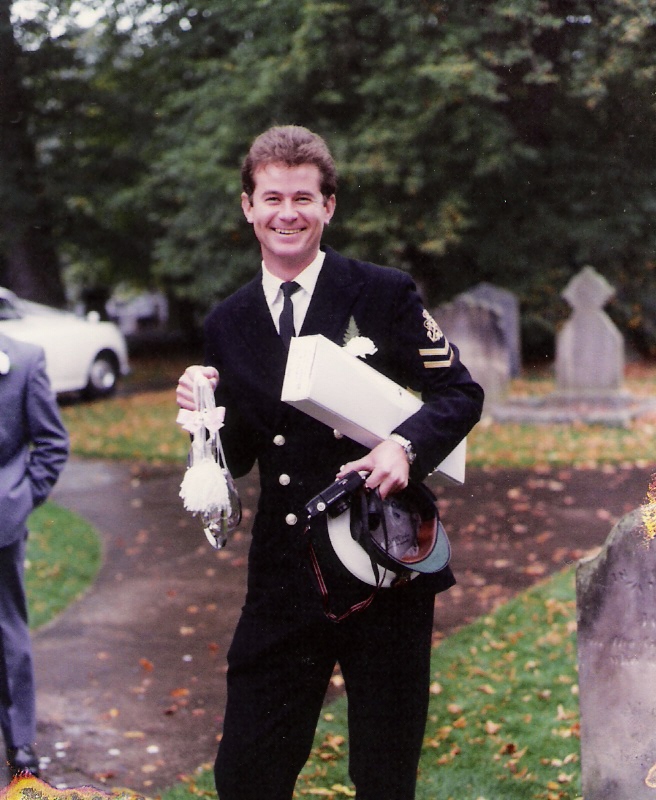
At a friends wedding
On completion of the run we set off for the pier and welcomed the Phoebe to Bournemouth our adopted town. We raised quite a few thousand pounds towards the building of the swimming pool at Linwood house, a unit for children with learning and physical disabilities.
We eventually returned to GUZZ and leave for us all and the installation of the new sonar began. Soon we were to set sail again for the trials and workup.
It was not long after that we began our first patrol and it was during those eight weeks submarines than any other vessel had done previous. We really did work hard and that the high point of my career came. The reason: me and my crew detected more utilised the equipment to it’s best enabling us to obtain a high detection rate.
HMS NELSON(CINCFLEET P) 1984-1988
I joined the Fleet Noise Reduction Unit at Commander In Chief Fleet, Portsmouth on the 12th November 1984.
My main job was to carry out ship inspections, I would inspect every compartment onboard a vessel looking for noise shorts and check that the machinery was mounted properly and report stowage areas were secure. The aim was to try and make the vessel as quiet as possible. A verbal report was given to the Commanding Officer and his senior engineers, return to the office and write up my report and send for typing up. Normally within a year or so I would return to the vessel to see how the crew had got on with rectifying the pickup points.
Warrant Officer Alan(Slosh) Wakeford was my Mentor he taught me everything I needed to know about Noise Reduction. Once when we visited a diesel submarine together he told me to crawl get in behind some machinery and pipe work I could not get there, so he showed me how, I will never forget the way he wiggled his body into the enclosed space, the reason he was able to do this was is a very experienced pot holer, he then showed me an area called the ‘snake pit’, this was a small area where one would climb down a ladder into a space full of pipes hence: ‘the snake pit’.
Just east of the Isle of Skye there is an island with an adjacent noise range, It took me two days to travel there by train again from Portsmouth to Glasgow, bus to the Airport then a flight to Broadway. The flight was in a small aircraft with probably about only twelve seats. After being in the air for around an hour and a half I noticed the navigator shaking his head, then it felt as though the aircraft was turning. We returned to Glasgow Airport, once landed the Navigator debriefed us and stated that there was heavy ice forming on the wings and they were lost, so they decided to head east and follow the coast around to the River Clyde and return to Glasgow. We had been in a perilous situation. So I returned to Glasgow Station and eventually boarded a train for the Kyle of Lochalsh an eight hour journey. I was collected by a military vehicle and taken to my accommodation for the evening where I had a bed for the night. The following morning before breakfast I had the greatest pleasure to view the beautiful scenery around the Kyle of Lochalsh.
Then a boat trip across to the Isle of Skye and a drive to Broadford Airfield where the final part of my journey would be to board a civilian helicopter to the island of destination. I will never forget thinking :How the hell will I get out of this thing if it crashed in the sea, as I was the first passenger in and would be the last escapee out.
When travelling to Scotland, either to Rosyth near Edinburgh or Neptune on the Clyde, we would board the train at Portsmouth Harbour to Woking from there we would catch the coach to Heathrow Airport. Board the scheduled ‘shuttle’ for a flying time of approximately one hour, as soon as the ‘trolley dollies’ started their serving of refreshments the race would be on to drink as many spirits as possible, I once managed eleven scotch and gingers, amazingly I was only a little tipsy on arrival at our destination. For some reason I have always been able to hold my whiskey,. The number of drinks one was able to down was obviously dependant on how busy the cabin crew were with the other passengers, if the passengers were as demanding as us, often the maximum number of drinks would often be only about five or six.
If I ever spent the weekend at Rosyth Naval Base I would always visit the wonderful city of Edinburgh and fit in a Football match at Easter Road, Home of Hibernian FC.
I flew to Hamburg to join HMS Cleopatra for a trip back to the UK inspecting the ship while on the short passage. Hamburg was very interesting, I think that I spent the whole evening walking up and down the Reeperbarn and visiting the Eros centre.
I went to sea with HMS Beaver for a week and on completion of my work I was due to be air lifted to HMS Ark Royal, the weather was too bad for this to happen so a transfer was planned during a replenishment, it was also too rough for this, so after a delay of a few days while waiting for the storm to subside I eventually had a helicopter transfer then after another couple of days I was transferred by Wessex to Lisbon Airport, apparently when nearing the airport we were very close to colliding with a passenger plane which was taking off. However, I eventually enjoyed first class travel back to Heathrow on a TAP airliner. Because of this delay I missed my brother inlaw’s wedding.
Sport/Squash
Photo 28
Instructors and Members of the Advanced Analysis Course
What a wonderful selection of ties
I came third on this course the submariners were not at all impressed
I was the only Skimmer there
Note: Skimmer-A member of the surface fleet.
Sun Dodger-A member of the submarine service.
HMS SHEFFIELD1988-1991
Photo 29

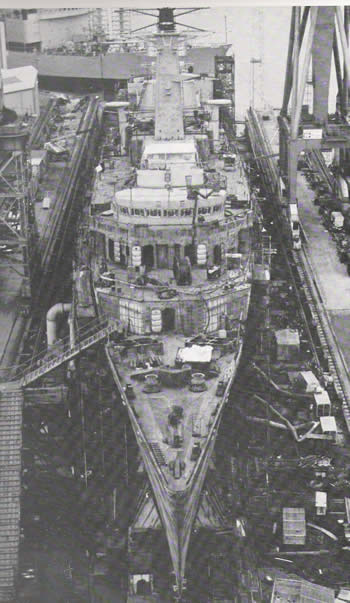
HMS Sheffield during build
Photo 30
HMS Sheffield
Prior to joining the Sheffield I had to complete the Nuclear Biological Chemical Defence Instructors(NBCDI’s) course At Phoenix Damage Control School, it was here many years earlier that I thought that the Navy had named something after me, it was the Damage Repair Instructional Unit(DRIU) pronounced DREW.
As well as my normal duties within sonar department I was also to be the Ships NBCDI,
I joined the Sheffield on the twenty third of February 1988 while she was in build at Swan Hunter shipyard Wallsend Newcastle, I was able to really get to know my ship before she sailed for Portsmouth and her trial period. Sheffield was commanded by Captain N J Barker soon to be relieved by Captain A Morton.
Captain Barker
The Falkland Conflict 1982
‘Word of the invasion of the Falkland Islands first reached Britain via ham radio. Britain was initially taken by surprise by the Argentinean attack on the South Atlantic islands, despite repeated warnings by Royal Navy captain Nicholas Barker and others. Barker believed that the intention expressed in Defence Secretary John Nott’s 1981 review to withdraw his ship HMS Endurance, Britains only naval presence in the South Atlantic, sent a signal to the Argentineans that Britain was unwilling and would soon be unable to defend her territories and subjects in the Falklands’.
Photo 31
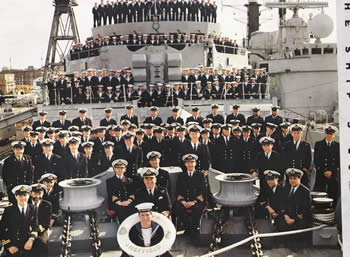
The first Ships Company of HMS Sheffield 1988
The commissioning of Sheffield took place at the port of Hull on the 26th July 1988, what a momentous occasion it was, the first time I had taken part in one. My Mother and Father and my wife Sharon also attended.
The Sonar department consisted of: CPO(OPS)(S) R J Drew, PO(S) Pete Stankevitch, PO(S) M(Micky) Dutson, PO(S) ( Big Mac)Macaravitz, LS(S) N S(Nick) Purgavie, LS(S) P(Sugar) Plumb, LS(S) G R(Charlie) Dorr, AB(S) D T P Pawley, AB(S) M Webster, AB(S) M P Gibson, AB(S) G P(Ginge) Garford, AB(S) J F(Jim) Inglis, AB(S) I A Henrys, S(S) A C Hansford, S(S) T C Carter, S(S) S A(Sean) Harrop, S(S) G A Fenwick.
We visited our capital city and birthed next to HMS Belfast in the Pool Of London. My Brother John and his wife Marion paid a visit to the ship one evening, John especially enjoyed his pints of courage Sparkling Bitter(CSB), we found a nice local restaurant afterwards and on returning to their car we found that a window had been smashed and a bottle of port had been stolen, this would have particularly upset my brother as he is a big fan of the liquid from Portugal.
Would you believe that I was allowed to be in charge of this beautiful ship when alongside the wall as Officer of the Day, Yes, I was responsible for the ship when in harbour on many occasion. Of course I would be relying on the experience and advice of fellow Chief Petty Officers, and if there were no Officers onboard, the final decision in the event of an emergency would be entirely down to me. WHAT POWER! Of course I would have to call in an Officer from ashore if need be, but basically the running of the ship was decided by Dickie Drew.
As the NBCDI, I was responsible for all training to do with Nuclear, Biological and Chemical Warfare and of course Damage Control and Fire Fighting, of which I put my heart into. When in Plymouth I had to ensure that the whole of the ships company tested their Anti Gas Respirators, these tests were carried out in the tunnels underneath the parade ground in HMS Drake Barracks. And annually I would organise a training day for NBCD throughout the ship with experts instructing various subjects, this we called NBCD It’s a Knockout!
I loved the power I had as a Chief Petty Officer onboard Ship, it was the peak of my career.
Photo 32
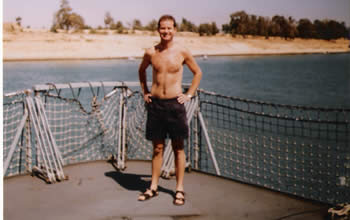
Transit of the Suez Canal enroute to the Gulf Patrol
Photo 33
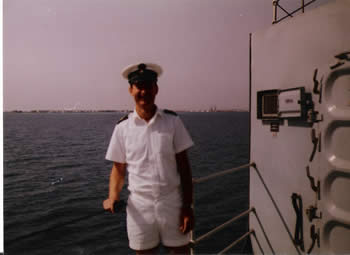
Just prior to Procedure Alpha entering Djibouti east Africa
HMS DRYAD 1991-1994
I never wanted to be drafted to HMS Dryad but it was inevitable as realistically where else was there to go to complete my last years service other than The School of Maritime Operations at HMS Dryad located just north of Portsmouth at Southwark Park adjacent to the small village of Southwark, as I was living in Waterlooville just north of Portsmouth at the time and it turned out to be perfect. I must admit I had never really enjoyed visiting HMS Dryad for whatever reason, but after I joined and had settled into my new job in the Sonar School, Lewin Building I soon realised that this was the perfect job for me to end my Naval career. I had so much knowledge and experience to pass on to the young men and women who I was to instruct, it was good for me and even better for them. During the next few years I received so much feedback from ships officers stating how impressed they were with the skills and knowledge of many of the students that I had taught,.
During my first couple of years I was teaching Leading Seamen Sonar Courses, they had completed their active training successfully and were now in the passive section.
I would be spending seven weeks in the classroom teaching analysis skills and for the final three weeks teach them how to operate the hardware(hands on button crunching).I cannot remember how many courses I taught, but by the end of my time at Dryad I had Instructed all ranks from Seaman up to Captain, I still retain an awful lot of the highly classified information, and it will remain with me until I go to my grave, and I suppose on my headstone an extra stamp could be made, in RED reading Top Secret, Limdis, Triplicate, UK/US Eyes Only.
During my last year at HMS Dryad the number of courses that were planned were greatly reduced, this enabled me to play even more sport, do a lot more resettlement courses, more probably than most others were able to do. I also volunteered as a tour guide in the Wall Map Room in Southwick House, which was presently the Wardroom. In 1994 it was the 50th anniversary year of the D-Day Landings, and the Wall Map room was to be open to visitors as part of the D-Day ‘celebrations’, The first group of visitors was a party of American Rangers, who had taken part in the attack and capture of Point du Hoc to the west of Omaha Beach in Normandy.
The D-DAY Landings is something that’s very close to my heart, as My Father was involved in them. At the time Dennis Drew was on ML 163, A motor Launch, Dad has showed me the yard where it was built and where he joined it at Teddington Middlesex, he sailed with it down the River Thames and out to sea for exercises etc, and helped to work the boat up,. Dennis has told me of his experiences during the build up to and the days during and after the Normandy Landings.
ML163 was one of the vessels that escorted the Rangers to Point Du Hoc with Omaha Beach to the east and Utah Beach to the west. I have been to the sight with my Father and he could have talked and talked about his experiences for ever which were helped by a couple of visiting Americans, it was wonderful to listen to them. Stood above the rocky peninsular at Point Du Hoc, remembering those times on ML163 coming into the shore with launches full of Rangers either side while watching the tracer bullets coming towards him, them returning to collect another fleet of launches
Photo 34
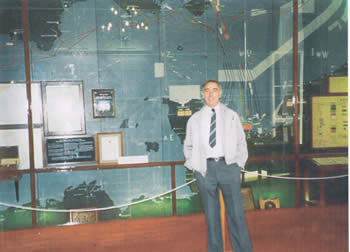
The Wall Map in Southwick House
I cannot remember exactly how many times I was guide in the Wall Map Room, but suffice to say that it was another thing that I thoroughly enjoyed, and it was so interesting meeting so many people with so many stories to tell of their experiences on that famous day in 1944, including 2 WRENS who were stationed at Southwick House and who had moved the ships around to their positions on this famous Map.
HMS Dryad itself was part of the ‘celebrations’ which were held in the Portsmouth
area on the 5th and 6th of June 1994, On the 5th June, we had a lot VIP’s visiting Dryad and initially I was to be in charge of a group of sailors who would be lining the road between the main gate and the Wardroom. It was pooring with rain continuously, so I had my troops taking cover until the Quartermaster at the main gate informed me of a VIP car approaching, then I would call my ‘troops’ out on the side of the road and order them to attention, and we would stand there until the car had passed. We were in our number 1’s (gold badge suits, our best uniforms) and at one time we were all standing there at attention this limousine stopped and the MP Malcolm Rifkind , he was at this time Defence Secretary, attempted to depart the vehicle. NO SIR! I said to him, you have to get your driver to continue along the road until you reach the large white building which is the Wardroom. I believe that this is was the only occasion that I spoke to a Member of Parliament during my Naval career. I also had the opportunity to meet HRH Princess Anne, what a lovely lady she was, and she chatted quite freely with our group of Chief Petty Officers later on in the day for what seemed like ages.
The following day on the 6th June I spent with my father on Southsea Common, where there was a fly past of various aircraft a sail past of ships while H M Queen Elizabeth and President Bill Clinton were also in attendance. This was a marvellous day, especially as the weather was nice and sunny, quite a change from the previous day.
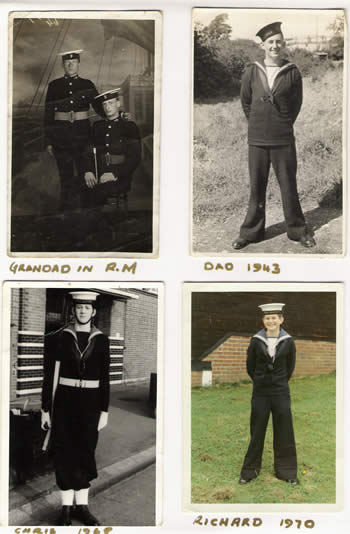
As can be seen from the above photographs, there is family history in the Royal Navy
Top left: My Grandfather, Samuel Elias Drew Royal Marines(standing), Top right: My Father Dennis William Drew Royal Navy 1943-1946, Bottom left my brother Christopher Antony Drew 1968 and Dickie Drew 1970. My youngest brother Ian also served for a few years, (photograph to follow.)
How proud we all look to be serving our country!
Sport, Sport, and more Sport.
While at Dryad I played more sport than ever before, why not take advantage of the numerous sporting facilities there including an eighteen hole golf course and a horse riding centre, about four or five squash courts, tennis courts, two Gymnasiums and a swimming pool. I became a bit of a dab hand at tennis, Squash and Badminton and would often be seen running around Southwick Park, kicking a ball around in the gym, snooker in the senior rates mess, an not to mention many a walk over the South Downs.
Every Wednesday afternoon during each course that I taught, there were 2 periods of sport programmed in, normally during one afternoon of the course, I would take the class on a walk over the South Downs, this normally terminated in a pub.
Once we managed to persuade the Boss to allow me to take a class to watch a county cricket match at Portsmouth between Hampshire and Worcestershire, where we witnessed Graham Hick make a century of runs. After a few drinks we were giving the players a bit of the normal Naval Banter and somebody sat in front of us actually turned around and accused us of being racist, bloody cheek.
In 1993 during the summer athletics tournament, I was participating in the three thousand metres race, I think that I was in third position at the time I passed the line when the bell was rung by a young sailor indicating that I had only one lap to go, I was not quite sure at the time as I thought that I had counted correctly believing that I still had two laps to complete so I took his word for it and virtually sprinted the whole of the final lap, on arrival at the line I was shocked when the Clubswinger informed me that I still had one more lap to do, I felt like ringing the neck the lad who was ringing the bell, needless to say I literally staggered around my final lap.
During the summer of 1994 there was to be a sports tournament between departments and I was the team captain and I actually scored my first goal in a competitive game of football on an outside pitch, yes the first goal in twenty four years, what an achievement! I was obviously elated.
The Chief Petty Officers was a lovely place to have a party or a dinner in, but one dinner I did not enjoy much was the pickle night we held one year, mainly because for some reason the Missile Senior Rates decided that it would be fun to flick mashed potato at each other, this I believed was not the done thing while in dinner suits and dicky bow ties.
The responsibility of Duty Chief Petty Officer came round about once per month, the worst part of this job was having to spend a night in an awful cabin, it was a lonely room empty of any decoration however I still managed to sleep well because I was always so tired by the end of the evening, It was always quite funny when I had to carry out rounds of the ladies accommodation as many a teddy bear were to be seen on the beds, and even funnier when similar toys were seen in the men’s block, one night a different type of toy was seen, it was an inflatable doll, I could not reprimand the culprit, it was only a joke and I was coming to the end of my time so I just laughed it off and passed by sniggering to myself.
Finally, I had to do some resettlement courses to assist me in resettling into Civilian life. I did as many one and two day course as I could possibly be spared for, I learnt quite a lot of interesting facts about various trades and finally I participated in a Safety Management Course, at the University of Greenwhich, Roehampton Campus, where I eventually acquired a Safety Management Diploma and qualified to become a member of the Institute of Occupational Safety and Health.
The day eventually came for me to be discharged from the Royal Navy, and the final thing was to report to the Regulating Office where I sat down at a desk in front of a Lading Hand and he cut up my Royal Navy Identity Card, that was it, I was now free to leave the service that I had loved for twenty four and a quarter years, GOODBYE MR DREW!
I joined the Royal Navy at the age of fifteen having not completed my secondary education. While serving I acquired four GCSE grades in English Language, General Studies, History and Mathematics. The day after I left, I returned to HMS Dryad as a civilian to sit the examination in Computer Studies and acquired my fifth GCSE grade.
Chief Petty Officer (Operations) (Sonar) Richard John (Dickie) Drew Royal Navy 1970 to 1994.